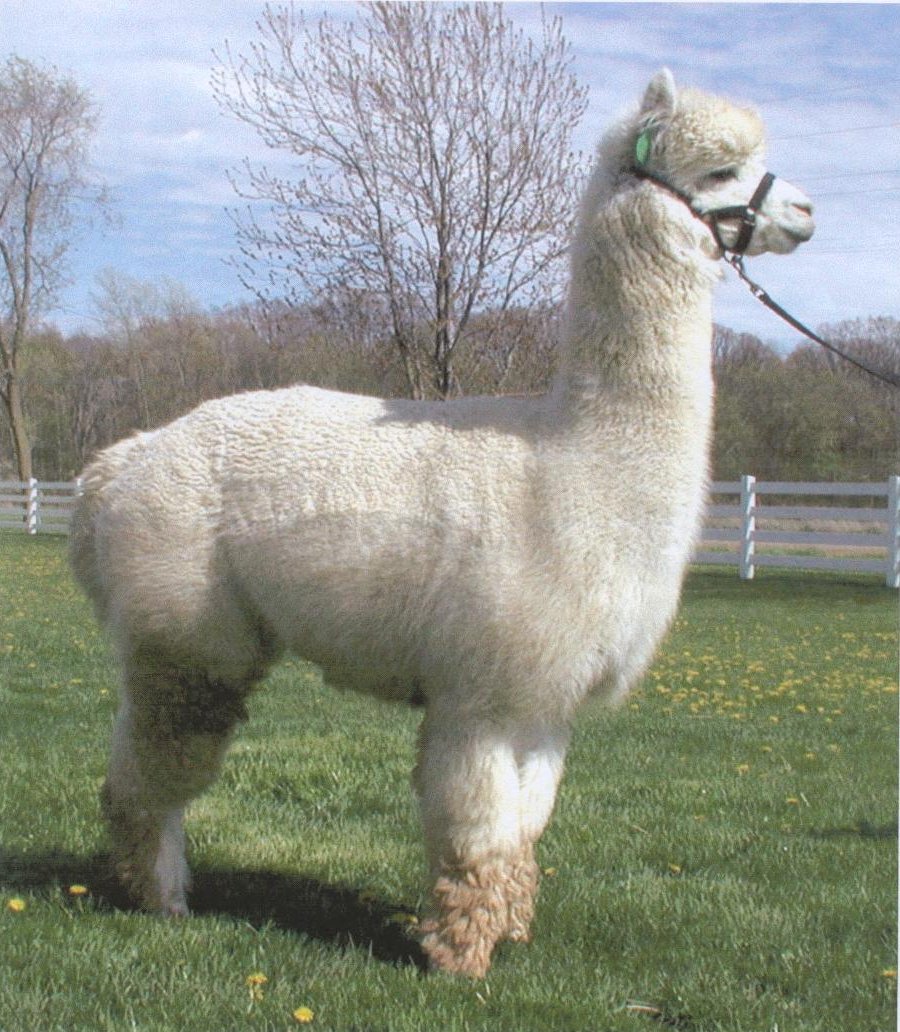
Subject: Alpaca Information File
Alpacas: Just the Facts
by Phil Switzer

Background Basics:

     Alpacas are members of the camel (camelid) family.  Camelids originated on the central plains of North America.  3 million years ago, the ancestral camelids migrated to South America.  By the end of  the last ice age, camelids became extinct in North America.  The  ancestral camelid developed into the present day wild vicuna and wild  guanaco of the Andean highlands (Peru, Bolivia, and Chile) of South  America.  About 5,000 to 6,000 years ago the natives began the domestication of the vicuna into the present day alpaca as a fiber producing animal.  They developed in the aplaca the following characteristics:

     Very fine, soft, dense fiber.

     Medullated, or hollow fiber, with very warm insulative properties.
Fiber that is almost free of guard hair and is "no-itch fiber".

     A small, very gentle, submissive animal for ease of shearing.
Over 20 natural colors that would not have to be dyed.

     Today (1994) there are about 4,000 alpacas in the U.S. and Canada.
Almost all of these alpacas have been registered and blood typed with
the International Lama Registry.  The blood typing helps to insure the
purity of the breed.


Physical Facts:

     Life span: About 18-20 years; average height: 3 feet at the
                shoulder and 4.5 feet at the head.

     Average weight: Adult, 150-185 lbs.  Baby, 16-20 lbs at birth.

     Average gestation: 11 months.

Birth:

     A baby is normally delivered without human assistance during
morning daylight hours.  Twinning is extremely rare.  The babies
(called crias) are normally up and nursing within 90 minutes.  They are
weaned at 6 months.

Reproduction:

     Females are first bred at 14-18 months of age.  Alpacas are
induced ovulators and can be bred at any time of the year.

Color:

     Fiber colors range from a true non fading black to brilliant white
with roans, pintos, browns, reds, fawns, rose grays, charcoal grays,
and others.

Fiber Production:

     The average production is about 4 lbs. per year per adult alpaca
and sells (in a clean state) for about $3 to $6 per ounce.  Shearing is
recommended every 1-2 years depending on climate.

Health:

     Alpacas are very hardy, healthy, and easy to care for.  In most
cases you will only have your Vet out twice a year for shots and other
maintenance procedures (depends on your area, ask your Vet).


Frequently Asked Questions:

What are they used for?

     They are used for breeding stock, fiber producers, pets, light
     pack animals, therapy, and investments.

Are they intelligent?

     Alpacas are intelligent and easy to train.  In just 4-5
     repetitions they will pick up and retain many skills such as
     accepting a halter, being led, and loading in and out of a
     vehicle.

Who do you sell their fiber to?

     Handspinners, yarn shops, and weavers are the major market for
     clean alpaca fiber.  They love all the various colors of alpaca.

What and how much do they eat?

     Alpacas are ruminants with three compartment stomachs.  They chew
     their cud like cattle and sheep.  They are very efficient and only
     eat 2-3 bales of grass hay per month.  In most cases, they require
     mineral supplements (ask your Vet).

Where can they be raised?

     In almost any climate.  In very hot climates, yearly shearing is
     required along with misting or sprinklers and shade.  In very cold
     climates, closed barns are recommended.  In most climates, a
     3-sided shelter is all that is required.

What is their personality like?

     Alpacas are very gentle and curious.  They are social animals and
     can be pleasantly dependent on humans.  With a little training
     they become great pets.  Alpacas will occasionally spit at each
     other when they are competing for food or trying to establish
     their pecking order.  Alpacas will not spit at people unless they
     have been abused by people.

What sounds do they make?

     Alpacas communicate with a series of ear and tail positions and
     body postures as well as a humming sound and a shrill alarm call
     when threatened by predators.

How much do they cost?

     (as of early 1994) Pet or fiber males begin at $1,000 (US) with
     stud quality males beginning at $4,000 and many selling for
     $10,000 or more. Weanling females begin at $13,000 and bred
     females at $16,000.

How can they be transported?

     They can be transported in a small station wagon (Subaru has been
     used) for short trips of an hour or so.  They require larger
     vehicles such as a mini-van, full size van, small trailer, horse
     trailer, or large truck depending on how many and how far you are
     transporting them.

Where can I get more information?

     The Rocky Mountain Llama and Alpaca Assn. represents owners and
     users of alpacas.  For more information, contact the Association
     at: 593 19-3/4 Road, Grand Junction, Colorado  81503. For
     information on alpacas and llamas, contact the International Llama
     Association, PO Box 37505, Denver, Colorado  80237. The Alpaca
     Owners and Breeders Association can be reached at: AOBA, c/o
     Hobert Office Services, Ltd., PO Box 1992, Estes Park, Colorado
     80517.

     A good source for alpaca information is the journal Llama Banner,
     which publishes "Alpacas" quarterly, along with bi-monthly issues
     of the Llama Banner.  Contact the publisher at: Alpacas Business
     Office, PO Box 1968, 714 Poyntz Ave.-Suite B, Manhattan, Kansas
     66502.  A yearly subscription is $24 US with an additional $9 per
     year charge for subscribers in Canada and Mexico.  You may
     purchase single issues at a cost of $4.00 US plus shipping.


Thanks to Phil Switzer of Switzer Land Farm for compiling this FAQ.
Contact Phil at: Box 3800, Estes Park, CO  80517     (303) 586-4624

File created 8/94.
http://netvet.wustl.edu/species/exotic/alpaca.txt retrieved 11/06/13


No comments:
Post a Comment